
The Nāgārjunian Catuṣkoṭi Applied to Pure Land Soteriology
Shaku Shin Gi
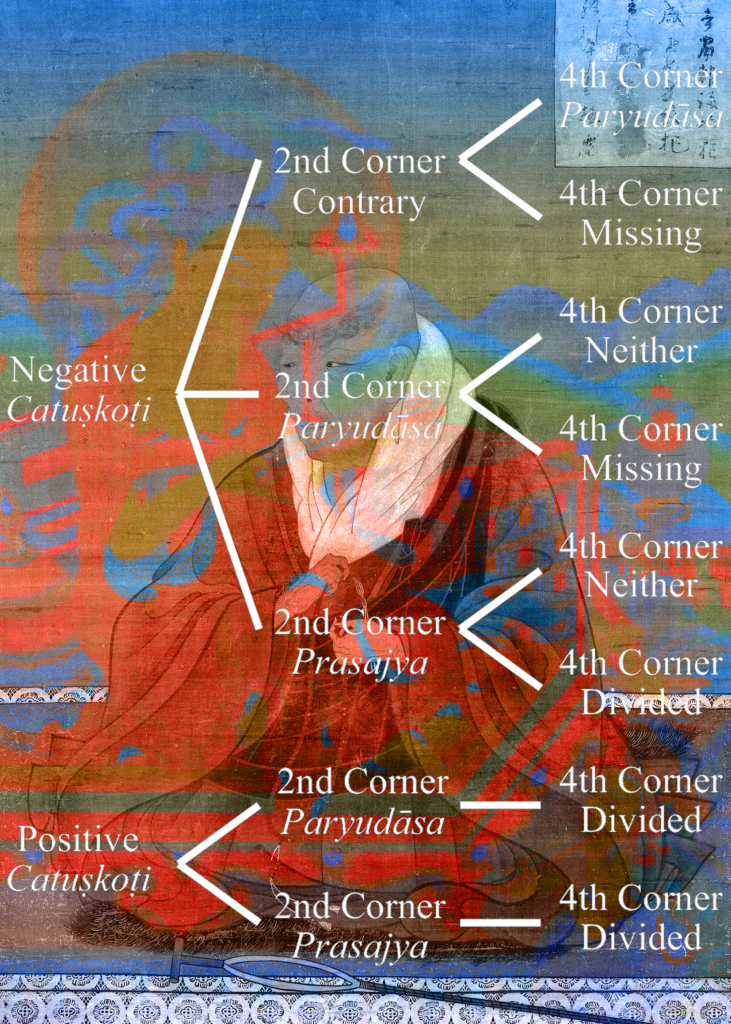
The use of the Catuṣkoṭi here does not aim to establish a correct position, but rather to create a field of conceptual exhaustion in which entrusting (shinjin) becomes possible.
1. Salvation is accomplished by the bonbu alone (self-power / jiriki)
“Salvation occurs through my effort and my practice, or through a faith that arises from my independent self.”
Negation:
- The bonbu is karmically blind. This means that we are affected by the karmic weight of past lives and of the present life. Not only are we affected by this karma, but we are also unable to accurately perceive where this karma arises or what its consequences will be.
- The being as an independent entity does not exist. We are conditioned beings who depend upon the totality of existence; this means that it is not possible to attain enlightenment through a self-effort separated from that totality. We depend absolutely on the causes and conditions that make our existence appear as real.
- The view of self-power gives rise to attachment to the self as something real and absolute. This attachment is like throwing coal onto the fire of delusions; if these delusions are intensified, Nirvana—the cessation of attachment—cannot be realized.
- The view of self-power produces a teleological conception of Nirvana as something to be attained “there.” Nirvana, by definition, is the unconditioned; if it were something to be attained, it would thereby become conditioned and would cease to be Nirvana. (“There is, bhikkhus, that which is unborn—unbecome—unmade—unconditioned. If there were not that which is unborn—unbecome—unmade—unconditioned, no escape from the born—become—made—conditioned would be discerned. But precisely because there is the unborn—unbecome—unmade—unconditioned, escape from the born—become—made—conditioned is discerned.” — Udāna 8.3)
2. Salvation is not accomplished by the bonbu, but by Amida as an external force
“Amida is a being external to me who saves me from outside myself.”
Negation:
- This is a form of theistic dualism in which Amida exists as an entity separate from humanity and the world. Such dualism cannot be sustained, since it would imply that Amida is a self-existent being; but if Amida were self-existent, he could not intervene in our existence without being “contaminated” by it, in other words, he could not save anyone.
- If Amida is not self-existent, this means that his existence depends upon ours; consequently, we also cannot be saved entirely outside of him, we must be part of him, and he part of us. This was expressed poetically by Asahara Saichi as follows: “According to Saichi’s understanding,
Ki and hō are one:
The Namu-amida-butsu is no other than he himself.
This is indeed Saichi’s understanding:
He has flowers in both hands,
Taken away in one way and given as gift in another way.” - It may be argued that Amida is self-existent insofar as he is unconditioned. This would mean that Amida is identical with Nirvana, which is also acceptable; however, as argued in the first negation, Nirvana, precisely because it is unconditioned, cannot be separated from the conditioned. Thus, a purely external salvation also proves philosophically unstable within a relational or dependent ontology.
- If Amida were a purely transcendental being, entirely separate from the world, speaking about him would be impossible or meaningless, since absolute transcendence cannot be reached, and a being that is absolutely transcendental cannot save, or even care about, the suffering of ordinary beings. A being that is totally transcendent is functionally nonexistent.
3. Salvation is accomplished jointly by the bonbu and Amida
“I entrust, and Amida does the rest,” or “I do one part and Amida does the other.”
Negation:
- This position is a moderate form of self-power. It still commits the same errors as the first and second positions by assuming a separation between myself and Amida.
- The cooperative model of salvation still affirms the necessity of my effort, thereby excluding and conditioning salvation upon those beings who possess the “correct” effort.
- As established in the first negation, the bonbu is a being burdened with immense negative karma accumulated over countless kalpas; who, then, would this being be to judge which effort is correct or incorrect?
- Amida is described as limitless, and therefore his power is also limitless, without boundaries. If his power knows no limits, what need could there be for the self-effort of the bonbu?
4. Salvation is neither of the bonbu, nor of Amida, nor of both (no salvation)
“In reality, no one is saved, and no one knows salvation either by self-power (jiriki) or by Other Power (tariki).”
Negation:
- This position is not viable. Nirvana is unconditioned; therefore, it cannot be separated from the conditioned. For no one to be saved, there must exist something called “salvation” and something called “non-salvation.” This position is a preference for “non-salvation”: it presents our world as one in which suffering and attachment are real, but liberation from them is impossible. Yet for non-salvation to exist, salvation must also be real, as previously shown, and this salvation must be not only real, but relevant and non-transcendent, as established in the second negation. To deny this would be to condition Nirvana.
- This is a pessimistic nihilism: the choice of suffering over liberation. When we choose “this” instead of “that,” we affirm the existence of both “this” and “that.” Thus, non-liberation cannot exist without liberation, nor can it be separated from liberation.
- It is coherent to affirm that salvation is not something to be attained externally, but to affirm salvation as nonexistent requires a subtle dualism and a dichotomy between salvation and non-salvation.
- To affirm non-salvation is to affirm the endless suffering of all sentient beings; yet the masters have already demonstrated effective and universal liberation both in practice and in theory. Attachment to the suffering of non-salvation creates a negative feedback loop and is also a universalizing attempt to affirm a category as absolute and independent. If any category could be absolute and independent, that category would be identical with Nirvana; and if any category is identical with Nirvana, then liberation is possible.
Question: The Pure Land masters and patriarchs explicitly affirmed salvation by Other Power (tariki), yet the second negation seems to contradict them. How can this be resolved?
Answer:
The second negation is by no means a denial of tariki as a soteriological function, but rather a denial of tariki as the substantial existence of Amida. In this sense, tariki should not be understood as the affirmation of Amida as a substantial and transcendent being, but as a pedagogical instrument of absolute negation. The great founding master, Shinran Shōnin, already taught that at the moment of salvation both Amida and ourselves vanish into the Nirvana of non-form:
“The buddha-nature is the true nature of reality, and the true nature of reality is the buddha’s cosmic embodiment. Therefore, we speak of two cosmic embodi-ments of “[Amida] buddha,” the cosmic embodiment in itself as the nature of reality and the cosmic embodiment as heuristic expression. The cosmic embodiment in itself as the nature of reality has neither form nor color; … words fall short in attempting to describe it.”
In this sense, tariki functions not as an ontological affirmation of a saving entity, but as a device of emptying that culminates in the simultaneous disappearance of the subject of salvation and its object.
Namu Amida Butsu
Namu Amida Butsu
Namu Amida Butsu
“Amida Buddha is the discovery of Absolute Emptiness. He is not something or someone to whom we should cling or to which we should add our self. On the contrary, Amida Buddha is a sharp sword of wisdom that severs the hands bound to the self. The sharp blade of the sword mercilessly cuts down the fool, burdened with desires and suffering.”
Shuichi Maida
